
Think about Rhode’s Peptide Lip Treatment, NYX’s Butter Gloss, and Dior’s Addict Hydrating Shine Lipstick. What do they have in common? Sure, the formulas are good and the packaging is pretty — but honestly, a huge part of their success comes down to the name. Before a customer ever swatches the product or reads a review, the name has already done a ton of work. It sets an expectation, triggers a feeling, and even tells Google what the product is about.
In beauty, a name is never just a label. It is a promise, a vibe, a search term, and a brand story — all packed into two or three words. And if you are building a cosmetic brand right now, getting that name right is one of the most important calls you will make.
The Market Is Huge — But So Is the Competition
The global lipstick market was valued at $20.1 billion in 2026 and is on track to hit $28.8 billion by 2031, growing at a CAGR of 7.48% 1. Moisturizing lip products specifically are growing even faster, at 9.55%
But here is the thing: more market growth also means more products fighting for the same shelf space and the same TikTok scroll. Thousands of new cosmetics launch every year. On Sephora’s website or a “For You” page, a shopper makes a split-second decision — click or keep scrolling. In that moment, the product name is often the only thing that gets a chance to speak.
In a crowded beauty aisle, a name is often the first thing a consumer notices — and the last thing they remember.
The brands that win are not always the ones with the best formulas. They are often the ones with the most memorable names.
Why Names Actually Work (There Is Science Behind This)
Consumer psychology research has consistently shown that product names influence purchasing behavior through two main mechanisms: the Fluency Effect E sensory association
The Fluency Effect is basically this: names that are easy to say and pleasant to hear feel more trustworthy. It sounds almost too simple, but the data backs it up. “Dibs” outsold “Snack-a-Bites” after a simple rename. “Chilean Sea Bass” became a restaurant staple while “Patagonian Toothfish” — the exact same fish — sat ignored. In cosmetics, this is why names like “Glow,” “Dewy,” and “Butter” keep showing up everywhere. They are short, soft, and feel good to say out loud.
Research consistently shows that the words on a label shape how consumers perceive the product inside — even before they try it.
Sensory association goes even deeper. When a name evokes a physical sensation — the richness of butter, the freshness of morning dew, the glossy look of glass — your brain starts imagining the product experience before you have even bought it. Rhode has mastered this with names like “Glazing Milk,” “Cinnamon Roll Lip Tint,” and “Strawberry Glaze.” They borrowed the emotional warmth of food to make skincare feel indulgent and fun . The result? Rhode went from zero to $212 million in annual revenue in under three years and was acquired by e.l.f. Beauty for $1 billion in 2025 .
That is not luck. That is naming strategy working exactly as intended.
“Moisture” vs. “Hydrating” — A Small Word, a Big Difference
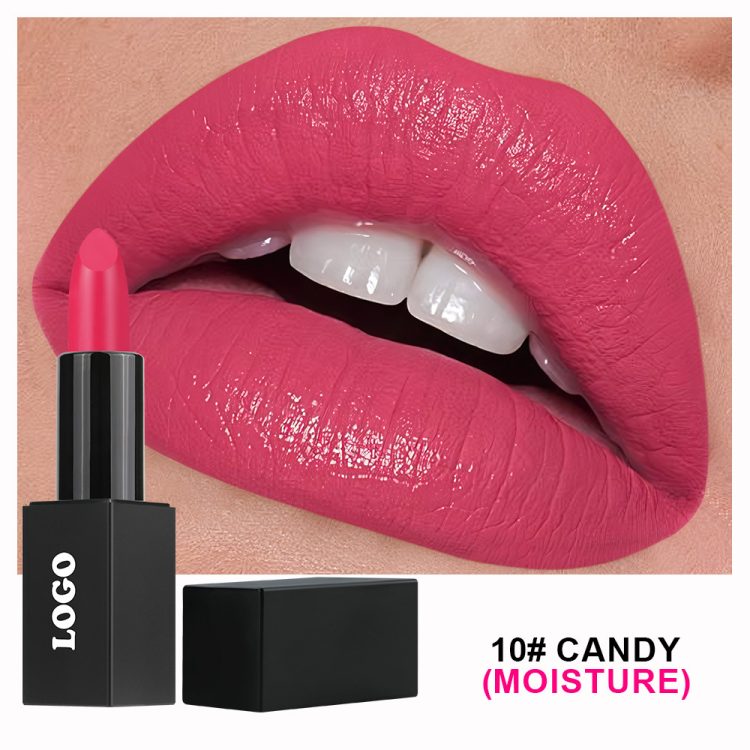
Vegan Lipstick Private Label
Let’s get specific. Say you are launching a moisturizing lip product. You might think “Moisture Lipstick” or “Hydrating Lipstick” are basically the same thing. They are not.
The Search Data Is Pretty Clear
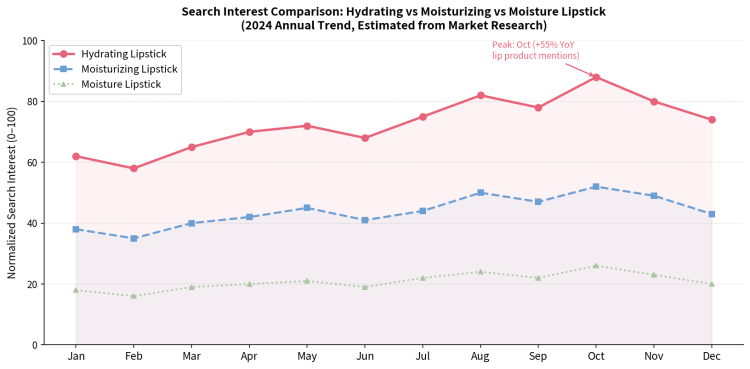
“Hydrating Lipstick” commands search interest roughly three to four times higher than “Moisture Lipstick” year-round, peaking sharply in autumn.
“Hydrating Lipstick” beats “Moisture Lipstick” in search volume by roughly three to four times throughout the year, with a sharp spike in October when beauty content on social media surges by over 55% year-on-year. “Moisturizing Lipstick” lands somewhere in the middle, while “Moisture Lipstick” barely registers.
Why? Because “hydrating” is the word real people actually use. Scroll through Reddit beauty threads, TikTok tutorials, or Sephora reviews and you will see it everywhere — “wet,” “juicy,” “dewy,” “hydrating.” That is the language of the consumer, and that is the language your product name should speak.
The Words Feel Different, Too
Beyond search numbers, these words carry different emotional weight. “Hydrating” is active and dynamic — it sounds like something is happening, like your lips are being restored and revitalized. It also connects naturally to the ingredient-conscious beauty movement, sitting comfortably alongside hyaluronic acid and glycerin on a label .
The “dewy glow” aesthetic — plump, luminous, water-fresh lips — is the visual promise that the best lip product names communicate instantly.
“Moisture” E “moisturizing,” on the other hand, feel more passive and clinical. They describe a state rather than a transformation. And in North American markets especially, the word “moist” has a subtle but measurable negative reaction among younger consumers — it is one of those words that just does not land well. For a brand spending real money on formulation, packaging, and marketing, that is a risk worth avoiding.
The takeaway is not just “say hydrating instead of moisture.” It is that every single word in your product name carries weight, and the difference between the right word and the almost-right word can show up directly in your search traffic, your social shares, and your sales numbers.
Five Naming Strategies That Actually Work
Looking at how the top cosmetic brands name their products, five clear approaches emerge — each with its own logic and its own audience.
The world’s most successful lipstick brands each use a distinct naming strategy — from ingredient-led to emotionally evocative — to stand apart on the shelf.
Strategy 1: Lead with the Ingredient
Example: Rhode Peptide Lip Treatment
Putting a key ingredient front and center — “Peptide,” “Hyaluronic,” “Ceramide” — speaks directly to the growing crowd of “Skintellectual” shoppers who actually research what they put on their skin before buying. It builds instant credibility and signals that this is a serious, skincare-grade product . Especially effective if your brand leans into science or wellness, and particularly powerful for reaching the 68% of luxury beauty buyers who now prioritize ingredient transparency .
Strategy 2: Make It Sound Delicious
Examples: NYX Butter Gloss, Summer Fridays Lip Butter Balm, Valentino Buttery Matte Lip Color
Food-inspired names are genuinely clever. “Butter,” “Glaze,” “Cinnamon Roll,” “Strawberry” — these words trigger multi-sensory associations that make a product feel immediately desirable. They also travel really well on social media, where a name like “Cinnamon Roll Lip Tint” becomes shareable content all on its own. Research shows that sensory naming turns a routine purchase into something that feels indulgent, which drives both first-time buys and repeat purchases .
Strategy 3: Name the Result, Not the Product
Examples: Glow Recipe Glass Balm Lip Treatment, NARS Afterglow Sensual Shine Hydrating Lipstick
Instead of describing what the product is, this approach names what it does to your face. “Glass,” “Glow,” “Dewy,” “Shine” — these words paint a picture of the end result, which is ultimately what people are paying for. Glow Recipe’s Glass Balm, launched in May 2025, became an instant bestseller by promising a “glass-like” finish — a perfect shorthand for the K-beauty-inspired luminous skin look that has been dominating beauty trends for years .
Strategy 4: Sell a Feeling, Not a Feature
Examples: Charlotte Tilbury Pillow Talk, NARS Afterglow
Some of the most iconic names in beauty history have nothing to do with ingredients or effects. “Pillow Talk” evokes intimacy, romance, and a very specific mood. “Afterglow” suggests the warmth that lingers after something wonderful. These names work because they do not describe a product — they invite you into a story. Charlotte Tilbury’s Pillow Talk became the best-selling lipstick shade in the United States precisely because the name created an emotional aspiration that went way beyond what was in the tube .
Strategy 5: Combine Function and Feeling
Examples: Dior Addict Hydrating Shine, Lancôme L’Absolu Rouge Hydrating Cream
Premium brands often pair a functional claim (“Hydrating”) with a sensory or visual modifier (“Shine,” “Cream”) to communicate both efficacy and experience at once. This works especially well for established brands where the brand name already carries emotional weight, and the product name just needs to clarify where it sits in the lineup .
Where the Real Opportunity Is Right Now
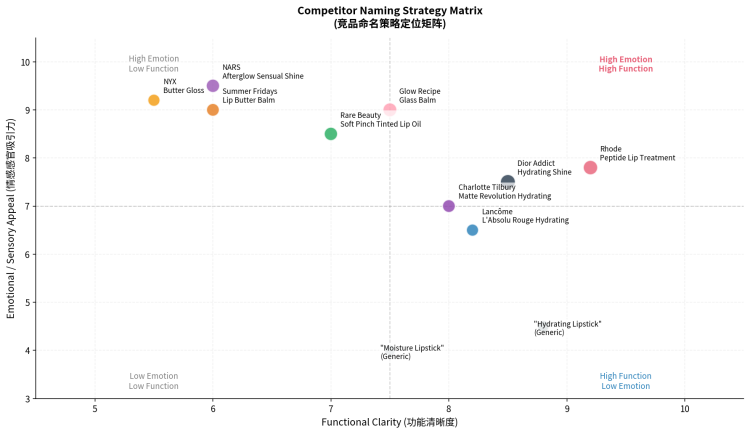
The most commercially successful products occupy the upper-right quadrant — high on both functional clarity and emotional/sensory appeal. Generic terms like “Moisture Lipstick” fall into the lower-right, where function is clear but emotion is absent.
If you map the major lip product players on two axes — functional clarity E emotional/sensory appeal — the pattern is pretty obvious. The brands doing the best numbers sit in the upper-right quadrant, where both dimensions are strong.
Rhode is there. Glow Recipe is heading there. But “Hydrating Lipstick” and “Moisture Lipstick”? They sit firmly in the lower-right — clear on function, but flat on feeling. They tell you what the product does, but they do not make you want it.
That gap is exactly where a smart naming strategy can win. Based on current trends, consumer psychology research, and what is actually selling, here are three naming directions that show real promise for new lip products entering the market:
| Nome | Strategy | Best For | Key Strength |
|---|---|---|---|
| Dewy Glow Lip | Visual outcome | Mass / new brands | Highest social shareability |
| Peptide Plump Lip | Ingredient + effect | Professional / skincare brands | Strongest differentiation & trust |
| Velvet Dew Lipstick | Sensory + visual | Mid-to-premium brands | Richest emotional resonance |
All three outperform “Hydrating Lipstick” and “Moisture Lipstick” on differentiation, emotional resonance, and brand extensibility — while still being grounded in the functional benefits people are actually searching for.
A Great Name Needs a Great Product Behind It
A great name needs a great product to back it up. Cohesive packaging design, quality formulation, and brand consistency are what transform a name into a lasting brand.
Understanding the power of naming is one thing. Actually executing on it — across formulation, packaging, and positioning — is where the real work happens.
This is where a manufacturing partner like Kasey Beauty comes in. With over 10 years of experience in OEM and ODM cosmetics manufacturing, Kasey Beauty works with brands at every stage — from formula customization and color development to packaging design and compliance documentation.
Once you have landed on a name like “Dewy Glow Lip” or “Peptide Plump Lip,” the next question is: does the product actually deliver on that promise? A name that says “dewy luminosity” needs a formula with the right balance of humectants and light-reflecting pigments. A name that says “peptide-powered plumping” needs an ingredient deck that can back that claim up. Kasey Beauty’s R&D team can help translate your naming vision into a formulation that lives up to it — and their ISO 22716 and GMP-certified manufacturing ensures that every product is safe, consistent, and compliant with FDA and EU regulations 11.
Beyond formulation, Kasey Beauty offers fully customizable packaging — from tube finishes and applicator types to secondary box printing in CMYK and PMS color systems — so the visual identity of your product actually reinforces the emotional promise of its name. A product called “Velvet Dew” should feel velvety and fresh the moment a customer picks it up. Packaging is the physical extension of your naming strategy, and getting both right is what separates forgettable products from ones that define a category.
For brands just starting out, Kasey Beauty’s 8-step private label process makes it straightforward to go from concept to market-ready product: choose your formula, test samples, select packaging, confirm colors, approve production, and ship — with support at every step and a 24-hour after-sales response commitment. The product range covers everything from lipstick and lip gloss to foundation, eyeshadow, blush, highlighter, and more, giving growing brands the flexibility to build a cohesive line under one well-named brand identity.
The Moment of Truth
The right product name sets an expectation — and the right formula fulfills it. Together, they create the kind of experience consumers come back for.
The moment a customer picks up a lip product, the name has already done its job — or failed to. A name like “Dewy Glow Lip” has already told her she will look luminous and fresh. “Peptide Plump Lip” has already told her this is a serious, science-backed product. “Moisture Lipstick” has told her… it moisturizes. That is a missed opportunity.
The best cosmetic names do not just describe. They promise, seduce, and inspire. They make a consumer feel something before she has even opened the cap.
The Bottom Line
The numbers do not lie: “Hydrating Lipstick” outperforms “Moisture Lipstick” in search volume by three to four times. Ingredient-led names like “Peptide” build trust that turns into repeat purchases and brand loyalty. Sensory names like “Butter” and “Glaze” create emotional connections that drive social sharing. And the brands sitting in that sweet spot — high functional clarity E high emotional resonance — are the ones generating nine-figure revenues and billion-dollar valuations.
Your product name is not a detail to sort out at the end of the development process. It is a strategic decision that shapes your formula, your packaging, your marketing, and your long-term brand architecture. Get it right from the start, and everything else becomes easier.
If you are ready to build a cosmetic brand with a name — and a product — that genuinely stands out, Kasey Beauty is ready to help you bring it to life.